Jest dominated testing for a decade. But Vitest (released in late 2021) changed things, and as of 2026, I believe it's the better choice for new projects.
Before Jest? A mini historyShow details
First released in 2014 (by Facebook), Jest was the clear dominant test runner for most of the last decade or so.
If you saw any JS test code, it was almost certainly going to be Jest. But then in late 2021/early 2022 Vitest was released and immediately everyone noticed how fast it was.
Before Jest there were a few other very popular test runners and test frameworks. The two main ones that are relevant for this blog post are:
- Jasmine (2010): Jasmine had most things built in, such as assertions and mocking/spy tools. Jest was built on top of Jasmine's API and runner (although it then forked and diverged quite a lot).
- Mocha (2011): Test framework where you used it with a test assertion library (like Chai) and mocking tools (like Sinon).
Then Jest was released by Facebook, and because it included everything needed (test runner, assertion library, mocking, snapshots, and more) it made it really easy to get set up and most new projects started using it.
But then a few years ago Vitest appeared (end of 2021), and I think as of 2026 there are many reasons to pick Vitest over Jest.
Yes, Jest still has more total downloads (30M vs 20M weekly as of early 2026 ), I believe mainly due to legacy projects and installed bases. But popularity does not mean best choice. What matters more is if Vitest solves the problems that Jest has and it can do it faster.
Here are the main reasons for justifying it, from my point of view.
I am not on a war against Jest!
At the end of the day for most projects it doesn't make too much difference which runner you use.
This article will seem like I am very much against Jest. I am trying to be fair and objective here with the reasons why Vitest wins most battles.
I've used Jest for years - and I still use it in many personal projects, and projects at work.
I feel I understand a lot of the Jest configuration options much better than Vitest. And here on HowToTestFrontend.com in the interactive test runners in the lessons I add, I made sure it is fully compatible with Jest or Vitest.
But you will notice, I am about to sound like I am trying to push everyone to use Vitest...
The syntax is basically the same - so there is little in terms of learning curve
As Jest is so popular, I would bet money that your team is already familiar with Jest. If you are creating a new project and adding testing from scratch, if you pick Vitest there is no extra learning curve.
The syntax can be almost exactly the same - you just replace jest.* with vi.*.
// jest:
expect(something).toBe(expected);
// vitest
expect(something).toBe(expected);

// jest:
const spy1 = jest.spyOn(someObject, 'fnName').mockReturnValue('hello');
// vitest:
const spy2 = vi.spyOn(someObject, 'fnName').mockReturnValue('hello');

// jest:
jest.mock('./myModule');
// vitest:
vi.mock('./myModule');

// jest:
beforeEach(() => {
  jest.clearAllMocks();
});
// vitest:
beforeEach(() => {
  vi.clearAllMocks();
});
For most of your test code, the only real difference is jest becomes vi. Of course there are some things that are only in Jest or only in Vitest, or where the syntax is different. But for the majority of day-to-day tests that you will write it is compatible.
On this website (HowToTestFrontend.com) I have built a test runner that runs in your browser.
So I can teach a lesson, and you can run it in your browser to play with the concept.
Because Vitest and Jest have such similar syntax, I was able to make my Jest/Vitest simulator very easily.
As part of my CI all my tests run in real runners and are fully compatible with both runners
Vitest uses ESM by default. Jest requires configuration.
Both support ESM now - but they approach it differently.
Jest was built around CommonJS in 2014, so ESM support requires extra setup, either like this:
{
  "type": "module",
  "scripts": {
    "test": "NODE_OPTIONS=--experimental-vm-modules jest"
  }
}
Or with complex setup using something like Babel and ts-jest.
Even with this, you sometimes hit SyntaxError: Cannot use import statement outside a module when adding ESM-only dependencies.
Vitest is built on ESM, so we don't need to deal with experimental flags, transformers and additional configuration.
Your test environment matches your build environment - so you are testing something much closer to your production app.
Developer experience (DX) is just better in Vitest
Developer experience (DX) is more streamlined, less stressful with Vitest.
Error messages are in my opinion clearer and easier to read (and I say this as someone with tons more experience day-to-day with Jest).
It also feels from watching the releases lately that Vitest is doing a lot more exciting updates and new features, and is the future (for now?) of JS testing.
Vitest --ui is amazing
If you have Vitest already set up, and you install @vitest/ui then you can run vitest --ui
This is essentially the same as running it in your terminal, but in a full UI in your browser.
(In UI mode, the tests still run "in" your console, it is just they get reported to you in the browser. Note: UI Mode is different to the Vitest browser mode)
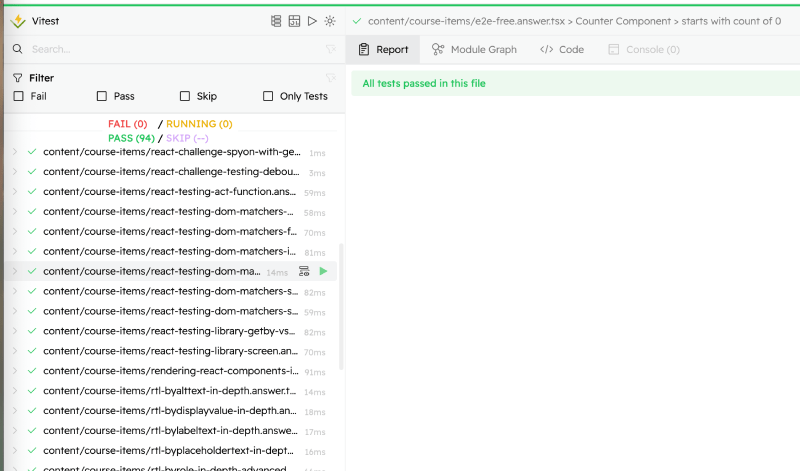
It lets you filter tests, run (and re-run) tests, see coverage and more - all in a visual GUI. All built into Vitest (assuming we can claim that installing @vitest/ui is part of vitest). Jest doesn't have this.
Use Vitest browser mode to run your frontend tests in a real browser
Vitest has a 'browser mode' that lets you run your tests in a real browser environment instead of the usual Node.js environment (a fake DOM).
This is quite new, but gaining traction. I predict that within a few years, we will run all our frontend tests via this. It is often faster, and more realistic than running it through our JSDOM fake environments that try to mimic a real browser.
You can run vitest --browser, and your tests will execute in a real browser (Chrome, Firefox, Safari, etc.).
This gives you access to the real browser APIs like window, document, localStorage, etc.
The syntax is the same as regular Vitest. It is very quick to pick up. Expect a lot more on this site soon about Vitest Browser Mode. It is very exciting to start using it.
Browser mode is different from the UI mode I mentioned earlier. UI mode gives you a nice visual interface for running tests, but browser mode actually changes where your tests run - from Node.js to a real browser environment.
This is definitely quite new and quickly evolving. It is ready for use in your CI/CD, but I am looking forward to the next few years and want to see where this goes!
I have an entire blog post highlighting how amazing I think Browser Mode is - read it here. It includes a guide on how to get it up and working in your existing Vitest config too
Testing types in Vitest - not possible in Jest
Vitest has built in support for making assertions against your TypeScript types.
Here are some examples:
expectTypeOf('hello').toBeString();

expectTypeOf(someBlogPost).toEqualTypeOf<{
  title: string;
  tags: string[];
  body: string;
}>();

const someNumber = 123;
assertType<number>(someNumber);
I have a full article you can read about type checks in Vitest - see here
Vitest can and often is faster than Jest
For tiny apps (like demo apps you see in tutorials), Vitest always seems much faster. With real production sized apps with lots of module imports and complex code, I am not sure it is always faster than Jest. One thing I have definitely noticed - it doesn't seem slower.
There are some reports that certain features are slower. But generally Vitest is the same or faster.
You can definitely notice the speed bump on cold start (when running tests for first time). There is less transformation and complex logic (which Jest has to do) when testing a typical modern app.
Watch mode (like HMR for tests) can and often is faster when re-running the same test files. And you can easily run tests in parallel (using worker threads) without much additional config.
Initial configuration of Vitest is often much quicker (as it normally works out of the box)
In my experience, getting Vitest configured from scratch and then getting your first test running is much easier and quicker in Vitest than Jest. It just works. Most of the time.
This is heavily helped by the fact that TypeScript and ESM imports are supported natively. Getting TypeScript and ESM working in Jest requires more complex configuration from the start.
Of course, this depends on each project, and my view on this is very much anecdotal.
If you already use Vite, then it makes no sense to use anything except Vitest
If your main application is built with Vite then using Vitest is a no-brainer.
When you set up an app with vite, you will have a vite.config.ts with your path aliases, typescript settings etc.
And you can use this same config (with minor tweaks) for your tests - this is really useful with things like path aliases. If it works in your test, the same config is used for the real app which means you are almost certainly testing a very realistic environment. The same cannot be said for Jest, and you often end up with subtle differences in how your app really behaves vs how it runs when tested within Jest.
In fact, you can even configure vitest from within your main vite.config.ts file - via the test property. Here is an example:
import { defineConfig } from 'vite';
import react from '@vitejs/plugin-react';

export default defineConfig({
  plugins: [react()],
  resolve: {
    alias: {
      '@': path.resolve(__dirname, './src'),
    },
  },

  // you can put all your vitest config here:
  test: {
    environment: 'jsdom',
    globals: true,
    setupFiles: './src/vitest.setup.ts',
  },
});
Note: if you use Next or another non Vite-based framework, it is still easy to get set up. I work with many apps and projects that have NextJS or other non Vite-based frameworks, but all testing is in Vitest.
TypeScript is so easy to set up with Vitest
Anyone who has set up Jest with TypeScript will know that it is a complete pain to set up sometimes. Every set up guide/tutorial has slightly different configuration, nothing seems compatible. With Vitest it just works.
Again to be fair here, if you set up Jest to test an app like NextJS, there are often official
plugins that will configure it out of the box (next/jest.js for example)
With Jest, you often have to install and configure ts-jest or babel-jest, set up transformation rules and so on.
With Vitest, TypeScript support is built-in and generally just works well straight away. No additional packages, no complex transformers.
Migrating from Jest to Vitest is often quite easy
This article is mostly about picking Vitest over Jest when starting a new project. But if you have an existing project that uses Jest then migration to use Vitest is often quite straightforward.
The Jest syntax (like expect(whatever).toBe(something)) is fully compatible.
The hardest part of a migration to Vitest in my experience is the configuration (jest.setup.ts and jest.config.ts). But once you get over that hurdle, most of your existing tests should probably work without major changes.
If you are thinking of moving from Jest to Vitest, check out their migration guide here .
"In source testing" - nice feature (but only for small apps or prototypes)
Vitest lets you write tests in the same file as your code, useful for small utility libraries:
I would never propose this in a big app, but it is great for small unit tests and prototypes.
function add(...args: number[]) {
  return args.reduce((a, b) => a + b, 0);
}

if (import.meta.vitest) {
  const { it, expect } = import.meta.vitest;
  it('add', () => expect(add(1, 2, 3)).toBe(6));
}
This is useful for small libraries or prototypes.
You can read more here in source testing
Other cool features in Vitest that you won't find in Jest:
- more advanced test filtering - such as testing a specific line in a file
vitest basic/foo.test.ts:10 - built in benchmarking - using
bench

But, despite all of this - there are times when you should definitely use Jest!
- Legacy codebases - especially if you already have Jest running there!
- Lots of support out there - Stack Overflow has 50,000+ Jest questions. Sometimes if you have a complex configuration or require jest only plugins, it might be less headache to use Jest.
- If you want to (or have to) use specific Jest plugins. Most of the big ones have Vitest alternatives, but there are still going to be some where it makes sense to continue using what works with Jest. There are also Jest plugins to make it work easily with existing Vite configs .
- Team familiarity. Apart from the initial set up of Vitest, most of your tests will look the exact same in Jest as they do in Vitest - just swap
jest.withvi.(likejest.spyOn()withvi.spyOn()) - Sometimes using Vitest with frameworks like NextJS can be more difficult.
Jest also has the advantage that on most teams, there will probably be more experienced engineers who know and understand how to use and configure Jest. (Jest has around a decade of being the most popular JS test runner).
Also remember, Jest is here to stay. But for most new projects, Vitest would have my vote.
Quick migration guide
Already using Jest? Here's the rough migration path in 5 simple steps
In summary...
For new projects in 2026, Vitest is the better default. It is more modern, easier to set up, and works better with ESM (which is probably how you build your production app).
Don't switch for the sake of switching. But if you're starting a new project today, pick Vitest.